



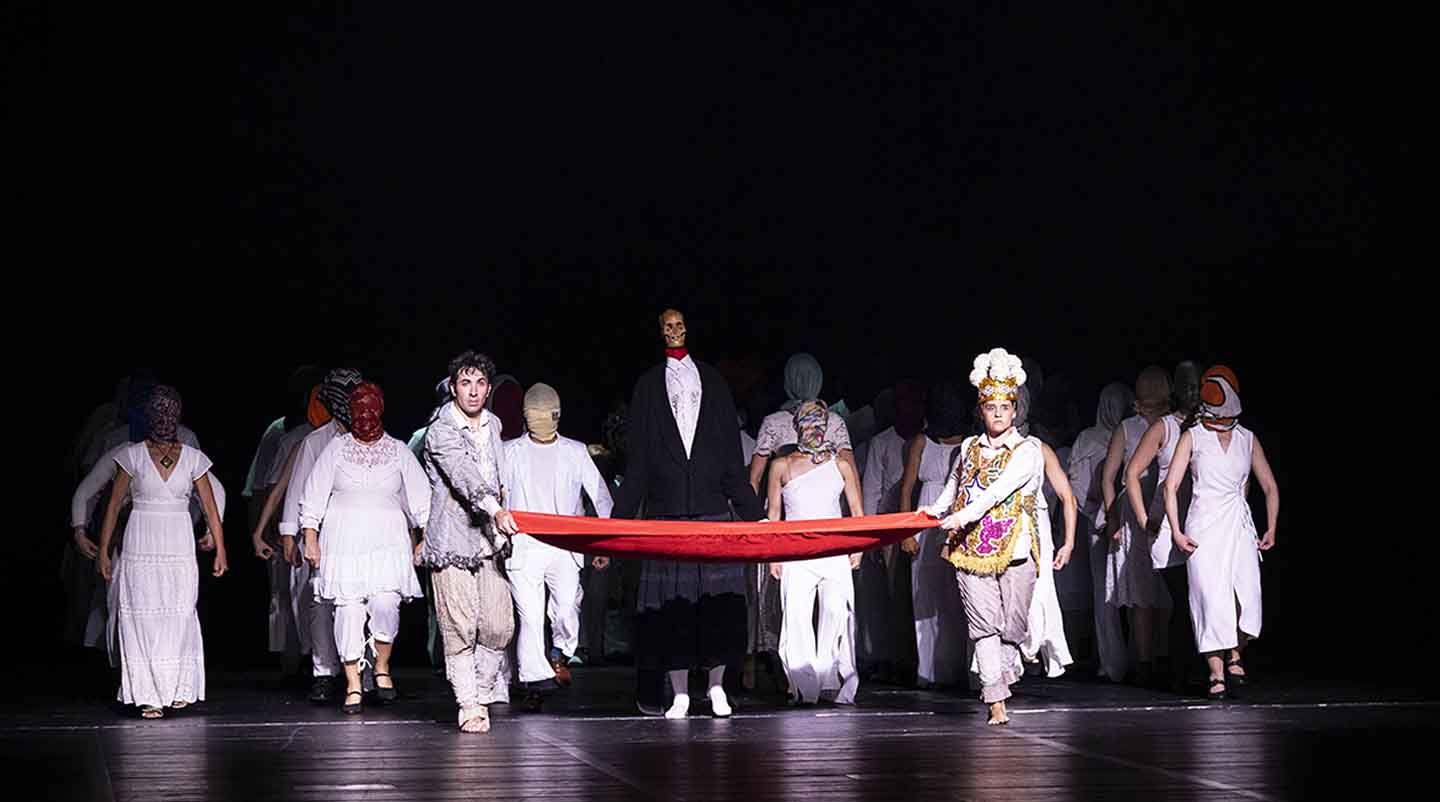
Eugenio Barba: Breaking the Rules – Research or Revolt
-
by
Eugenio
I have never thought in categories of ‘research’. I admire those who claim to do research, I appreciate their various developments and results, and I am aware of their importance for the ecology of our craft. But ‘research’ has never motivated my decisions.
Perhaps a spectator or a scholar may consider my professional efforts as ‘research’. I have always thought, and still do think, that theatre is the performance, the corps-à-corps between actors and spectators. Theatre is the spectator. This is our professional identity and specificity, from a historical and technical perspective.
The dimension of ‘research’ – breaking with habits, parameters and usual criteria – is for me organically inherent in the process of the actors’ development while rehearsing a performance. Every director follows a different path.
My approach is to twist the various improvisations of individual actors and weave them into dramatically zigzagging and ambiguous scenes. I see it as my task to stimulate the actors to respond in ways that physically and vocally intensify the story’s details, affecting the spectator’s nervous system and imagination.
The results amaze even us who have triggered and shaped this process. This need to construct situations that cannot be rationally controlled stems from my inability to put together a performance in a few weeks.
It was a form of insecurity; after more than sixty years of experience, it has become an ‘active waiting’, a process that allows the unexpected to happen. This is why I extend the rehearsal period for months and months, sometimes years.
The examples often cited today as ‘research’ – Stanislavsky, Vakhtangov or Meyerhold Studios – were theatre schools, the first to emerge in the 20th century to prepare actors for the challenges from innovative playwrights like Ibsen, Strindberg, Chekhov, and later the Symbolists Maeterlinck, Hamsun and Andreyev.
These schools were often within a theatre, at other times outside, and trained actors who would later enter the ‘Market’ of entertaining or subsidised show-business. The Actors’ Studio in New York or Etienne Decroux’s house-school in Paris are well-known examples. However, there was a world of difference between these two places: the first prepared for the ‘Market’, the second refused to consider it and Decroux sent away those students who attempted to approach it during their studies.
The ‘Market’ is not a negative entity. It is the context of traditional, geographical, cultural, social, political and technological reality. It is the arena of our economic survival.
The Market is the place of encounters, negotiations, agreements, constraints, confrontations and disagreements that determine the value of the essential relationship to which Jerzy Grotowski reduced theatre: actor and spectator. Such a relationship can only exist thanks to the endeavours and solutions with which each of us opposes the Market in order to protect one’s own autonomy.
If we want to create a performance, we must take into account politicians and patrons, theatre laws and fashions, available spaces and architectural models, modes of information, production/distribution systems, and individual artistic, educational, political, therapeutic and spiritual aspirations. The construction of the actor-spectator relationship is a struggle between pragmatism and idealism, refusal and consensus, resistance and acquiescence.
The Market is the spirit of the times, the specific historical setting in which we resist, but it is also the fluid mass of an ocean in which, like fish, we artisans of the stage swim. We can follow the currents, swim against them, try to avoid them by flattening ourselves against the bottom or attempt to become a flying fish to escape the flows and pressures of this imprisoning liquid world. Each of us chooses how to face the Market.
The Market is a fundamental dimension of the live performance profession, along with its complementary aspect: ideality, the value each of us attributes to our craft, the intimate meaning that drives us to persevere.
In this polarity, theatre – as an encounter with the spectator – becomes a particular system of production and specific creativity with a network of relationships that sometimes produce a parallel, outsider environment, yet strongly connected to its epoch: a theatre group.
The Italian historian Nando Taviani called these parallel environments ‘enclave’. I am interested in maintaining the diversity and incommunicability of the individuals who constitute my enclave, my theatre group, my floating island. I am passionate about intertwining this difference with the difference of other theatre enclaves that seek to resist the pressure of the water above.
‘Research’ is not a force that drives me, I am interested in politics by other means – those of theatre – a ‘politicality’ which offers the possibility of keeping alive an environment with a focus on building other types of relations.
Politics is a longing for change, a rejection of the limits of what is considered possible, a need to create impossible situations. This is my profession – my revolt and solitude – with my daily tasks at Odin Teatret.
It is not ‘research’, it is politics. This is why I speak of a ‘tradition of the impossible’ that runs through the professions of dance and theatre and reveals the ability of certain figures to achieve what their contemporaries considered impossible.
Here I must remember Isadora Duncan and Stanislavsky, Meyerhold and Vakhtangov, Bertolt Brecht and Helene Weigel, Judith Malina and Julian Beck with their Living Theatre, Joan Littlewood and the Theatre Workshop, Ariane Mnouchkine and the Théâtre du Soleil, Santiago Garcia’s and Patricia Ariza’s La Candelaria, and the countless group theatres across the planet – those I call Third Theatre – who have invented production systems, techniques and creative modalities to reach spectators in the wounded and neglected areas of our society.
Were they driven by a desire for aesthetic and artistic research, or by a spirit of revolt against the stagnant, complacent and unjust conditions of our craft and of the society of our time?
One step at a time towards technical coexistence
However far we wish to go, however high we feel the need to continue climbing, we must always begin with a small step.
The International School of Theatre Anthropology (ISTA) was not born out of a need for original research. In 1980, Hans Jürgen Nagel, director of the Kulturamt in Bonn, Germany, proposed to me to organise an encounter/festival of theatre groups. I made him a counterproposal: the rather indefinable project of a ‘non-school’.
I envisioned it as a ‘technical coexistence’ based on the exchange of practices between actors and dancers from different cultures and traditions, as well as reflections on the present and past by scholars, choreographers, anthropologists, group theatre directors and recognised performers of Asian traditions. Was it possible to define the factors that determine the effectiveness of the actors’ and dancers’ different techniques around the world?
I established ISTA, this ‘non-school’, with university scholars to whom I was bound by deep friendship and constant exchanges. They were joined by Asian performers I had invited to Odin Teatret and with whom I had often collaborated. But what should the first step be? I had no doubt: the first day of their apprenticeship.
Hence my unreasonable and unwavering obsession with demanding that these outstanding artists and scholars reconstruct in detail what had happened during their first encounter with the person who had taught them the rudiments of their craft.
For every artist and craftsman, in a creative process, the determining factor is not rational. It is spontaneous, uncontrollable and intuitive. It is through the wounds of a biography that a vocation for the theatre becomes art and transcends it.
Vocation is an escape. It arises from disagreement with family, from conflict with the world, from a permanent intolerance or insurrection, from an inability to adapt and a feeling that we are not taken into consideration. Vocation can be realised by throwing oneself into the fray of politics, activism, dissent and conflict.
Or, on a smaller scale, more modest but no less effective, it takes shape in a church, a school classroom, a cultural association or a theatre group.
Theatre, or rather the actor’s technique, is not just a means, it is also an end, and in order to ‘be’ it must ‘exist’. Being a good actor doesn’t mean being a good activist but rather being able to manipulate and intensify the ‘life’ of stage fiction to reveal its inner reality. Stage ‘life’ precedes narration, anecdote and what is evident.
Dance is proof of this. This material and concrete ‘life’ follows a force: the intuition of beauty that moves us as vulnerability, transcendence, refusal, impulse to resist, nostalgia and obsession.
Stage fiction reveals not only reality, but also its opposite: what is unseen, what cannot normally be perceived. Just as in literature characters are made of words and the way these are intertwined, so in theatre, characters are made of tensions, of changes and leaps of energy.
A smile is the consequence of two hundred and fifty tensions in the body. Tensions are partitions, the dividing walls on which the narrative and evocative structure (dramaturgy) is built. These dividing walls can be built without considering the rules that seem to dominate our profession and the Market.
We could say that the alchemy of theatre, with its multiplicity of approaches, consists in transforming misfortunes into painful beauty, challenging the certainties of common sense and defending a personal freedom that we feel as a moral duty and a physical necessity.
All this can only happen through a physical and vocal artificiality that paradoxically becomes more intense than real life.
Bringing heaven down from the sky and planting it in the earth, in the actor’s living body. Theatre anthropology helps make this possible.